
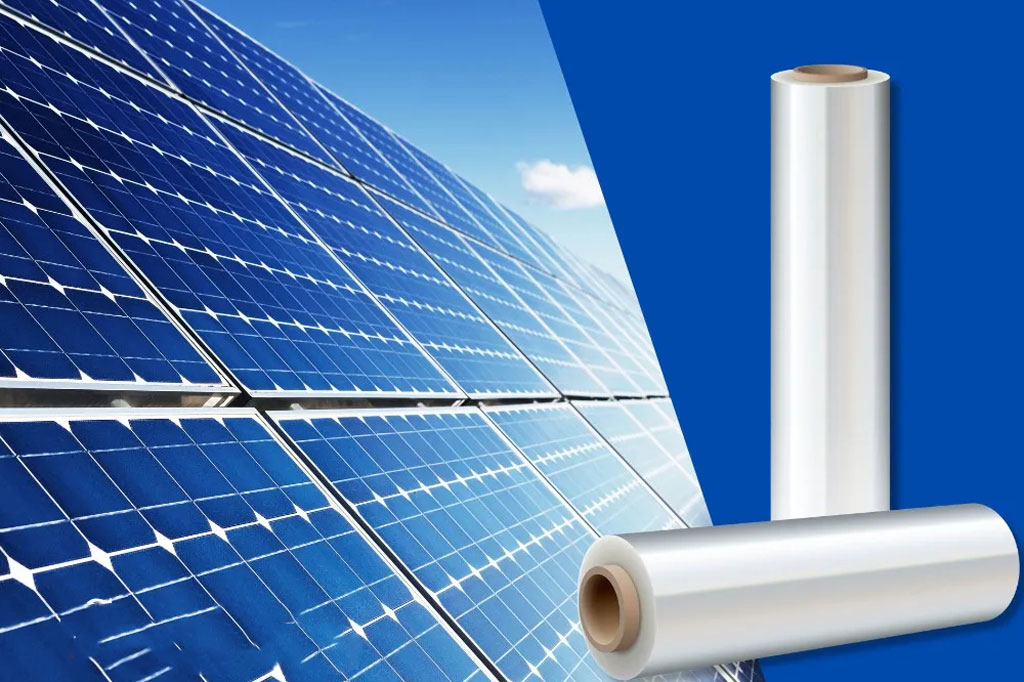
In recent years, PTFE films have found increasing use around photovoltaic (PV) modules as protective layers, anti-soiling surfaces, and component interfaces.
While PTFE doesn’t change the semiconductor physics inside a solar cell, it improves the real-world energy yield and lifetime of solar panels by addressing the environmental and mechanical factors that reduce delivered power over time.
Key PTFE Properties that Matter for PV
Several intrinsic material properties make PTFE attractive for solar applications:
- Very Low Surface Energy and High Hydrophobicity: Water and many contaminants bead and roll off PTFE surfaces, helping keep the glass or cover layer cleaner.
- Excellent UV and Weather Resistance: PTFE resists photochemical breakdown, retaining its properties under long-term solar exposure.
- Thermal Stability: PTFE withstands a broad temperature range without significant mechanical or chemical change.
- Chemical Inertness: It resists acids, bases, and salts that can attack other polymers or adhesives.
- Low Friction and Anti-adhesive Character: Dust and biological growths are less likely to stick to PTFE-treated surfaces.
- Electrical Insulation and Dielectric Strength: Useful where films are placed near electrically active components.
Taken together, these characteristics let PTFE films serve as durable protective skins that maintain optical clarity and reduce soiling, two major contributors to performance loss in fielded solar installations.
How PTFE Film Improves Energy Yield?
1. Reduced Soiling and Easier Cleaning
Soiling — accumulation of dust, pollen, bird droppings, and other particulates — is a leading cause of performance losses in PV arrays, especially in arid, dusty, or agricultural regions.
PTFE’s hydrophobic, low-energy surface causes water droplets to bead and roll away, carrying loose dust with them.
In practice, panels with PTFE-treated top layers require less frequent manual washing; rainfall is more effective at self-cleaning, which maintains higher optical transmittance more of the time and thereby improves energy yield.
2. Stable Optical Performance under UV Exposure
Cover and encapsulant materials can yellow or degrade under long-term ultraviolet exposure, reducing the light that reaches the cells.
PTFE films are highly UV-stable, resisting yellowing and embrittlement.
When used as a protective overlayer or as part of a multilayer cover, PTFE helps preserve the module’s optical clarity and spectral transmission over many years, so the nominal power rating is closer to the power actually delivered in year 5, 10, or 20.
3. Reduced Microabrasion and Mechanical Wear
Modules in windy, sandy environments experience abrasive wear on their cover glass or polymer layers.
PTFE’s low coefficient of friction and abrasion resistance reduce the rate at which particles abrade the cover, slowing the formation of micro-scratches that scatter light and lower transmittance.
4. Improved Thermal and Moisture Management
PTFE’s thermal stability and resistance to moisture ingress when used as an edge seal or as part of a backsheet system help protect internal module components — junction box adhesives, EVA encapsulant film, and busbar contacts — from accelerated degradation.
Stable module internal temperatures and reduced moisture-related delamination both contribute to long-term retention of module efficiency.
5. Electrical and Environmental Protection for High-Reliability Installations
In specialized PV applications (floating solar, maritime, desert installations, or concentrated PV), corrosion and chemical attack can threaten reliability.
PTFE’s chemical inertness and insulating properties provide a resilient barrier against corrosive aerosols, salt spray, and industrial pollutants, reducing failure rates and downtime.
Design and Integration Considerations
To extract the performance benefits of PTFE, designers must think beyond simply “stick PTFE on top.” Important practical considerations include:
- Optical Clarity and Thickness: PTFE in thick, milky sheets is not appropriate over cells because it scatters light. For top-layer use, very thin, optically clear PTFE films or ultra-thin laminates are chosen to minimize transmission losses.
- Adhesion and Lamination: PTFE’s low surface energy makes it difficult to bond with conventional adhesives. Surface treatments, primers, or mechanical laminating approaches are often needed to ensure stable attachment without delamination.
- Surface Texture: Smooth PTFE offers hydrophobicity, but engineered micro- or nanotextures can enhance anti-soiling and superhydrophobic behavior. Texture design must balance water roll-off with optical scattering.
- Compatibility with Encapsulants and Edge Seals: PTFE must be chemically compatible with the module’s encapsulant (e.g., EVA film, EPE film, POE film, or newer gel-type materials), edge sealants, and framing materials to avoid unwanted interactions during lamination and in service.
- Cost and Manufacturability: High-performance PTFE films or specially treated variants cost more than standard glass covers. Designers weigh the upfront investment against potential savings in cleaning, maintenance, and extended energy production.
Limitations and Environmental Considerations
PTFE is exceptionally durable, which is a double-edged sword. Its persistence makes recycling and end-of-life disposal more challenging than for some simpler polymers.
Also, PTFE is not inherently anti-reflective — if a PTFE layer is not carefully engineered, it can introduce additional reflections or scattering that reduce light coupling into the cell.
Finally, adhesion issues mean PTFE is not a drop-in replacement in conventional lamination lines without process modifications.
Manufacturers and integrators therefore often consider PTFE as one component in a hybrid strategy: combine glass or fluoropolymer backsheets, textured PTFE top layers, and tailored adhesives to achieve the best tradeoff between optical performance, durability, and lifecycle impacts.
Practical Outcomes for PV Operators
When correctly applied, PTFE film technology helps keep modules cleaner, reduces degradation from UV and abrasion, and protects against corrosive environments — all of which translate to higher energy yield and lower operation and maintenance costs over a project’s lifetime.
For large, utility-scale arrays in dusty climates or for floating and marine installations where salt and biofouling are concerns, the durability and anti-soiling benefits can be particularly valuable.
Conclusion
PTFE films don’t make solar cells more efficient in the lab, but they do make solar panels more reliable and productive in the field.
By minimizing soiling, resisting UV-driven aging, reducing abrasion, and protecting sensitive internal components, PTFE helps installed PV systems stay closer to their rated power longer.
Thoughtful engineering — selecting the right film grade, texture, thickness, and adhesion method — is essential to realize the benefits without compromising optical performance or recyclability.
For operators and designers focused on lifetime energy yield and reduced maintenance, PTFE-based solutions are a compelling option to include in the toolbox.